


The new Support Needs Assessment (SNA) model will directly count your overall NDIS budget based on your everyday task difficulties. Instead of negotiating individual line items with a planner, an independent assessment process will provide a set amount of funding for your plan. This will initially change how your total NDIS budget is calculated, structured, and spent over longer periods.
Searching for the right NDIS plan always felt a bit hard for you. The federal budget 2026 ndis updates are underway, and the system is transitioning to New Framework Planning. If you are living with a disability or caring for someone who is. You’re likely asking yourself what this means for your everyday support. In this article, let’s look at how the New Needs Assessment Model impacts your NDIS Budget.
The End of a Diagnosis-First Model: What is Changing?
Getting NDIS funding is a hassle of medical paperwork for years. Imagine you were diagnosed with a serious condition such as autism. Now, you would have collected piles of prescriptions to validate your diagnosis. Like this, there were significant problems with the old system. Two people with the same diagnosis can have completely different daily lives. But the funding models weren’t always that.
The new model is particularly concerned with “functional needs.” So, the NDIA is interested in what you’re able to do and what you’re not. There is a real fear that standardized tools might ignore the invisible hurdles of complex conditions. That led to unexpected ndis funding cuts.
How Does the New Support Needs Assessment (SNA) Work?
The new framework is based on standardized assessment tools, such as the updated I-CAN v6 framework. In such a case, a planner doesn’t look only at your doctor’s reports. A trained assessor will evaluate your ability in 12 areas of everyday life. These include areas such as communication, social interaction, mobility, and self-care.
The assessment usually takes the form of a detailed interview. It’s important to be honest during these interviews about your challenging times. We refer to this as the worst-day principle.
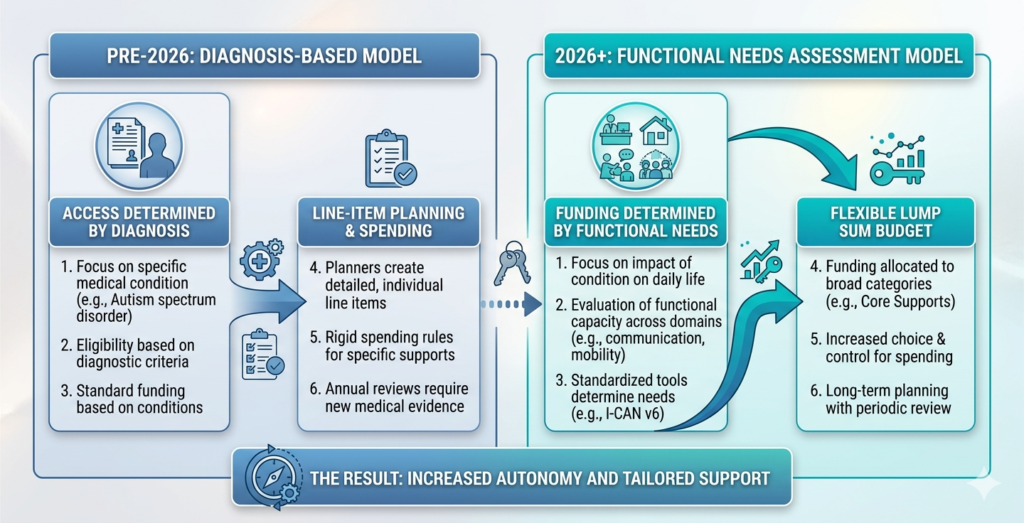
How the SNA Model Sets Your Total NDIS Budget
The SNA result will not create a plan line, but will place your functional profile in a funding band. This is the minimum amount your total ndis budget will be. The government argues this gives participants more choice and control ndis funding.
Because you receive a lump sum that you can spend as you wish, not in boxes.
But a major concern for families is the “budget gap. If the standardized tool suggests that you have moderate needs, but your actual expenses, such as special home setups, are high. Then, you might face a funding gap.
Understanding Your Funding Categories and Periods
Your total ndis budget, once you’ve decided on it is split into specific categories. The majority of participants are spending the biggest proportion of their ndis core support budget.
Core and Transport Funding
Your core NDIS funding is for the basics, such as your daily personal care and access to the community. The beauty of the NDIS core supports is their flexibility. Generally, you can move money around in the year as your needs change.
There is also some shift in transport ndis funding in these categories. Depending on your situation, transport support might be paid directly. This is to help you get to community activities, work, or therapy appointments. If you need specialized transport options, you can check out how to set up tailored transport funding setups.
Longer Funding Periods
We are also seeing a major shift in NDIS funding periods. The NDIA is transitioning from 12-month plans to longer funding periods, typically 3 or 5 years.
Fewer stressful annual reviews mean longer plans! It also means you need to watch your spending, though. If you burn through your funds too quickly in the first year. For you, getting top-up funding will be incredibly difficult.
You can use official tools such as the NDIS budget calculator to stay on track.
Manage Your Budget In The Future
The new framework planning model is shifting how every NDIS budget is built across Australia. Therefore, once you know the new rules, you can speak up for yourself! The advice is to maintain clear records and concentrate on how your disability affects your life in your interview.

Specific Funding Impacts: Autism, MTA, and Daily Supports
The transition to functional assessments changes the scenario for specific types of care-
NDIS Funding Autism Spectrum Disorder
In the past, receiving NDIS funding autism support depended heavily on the severity level noted in the clinical diagnosis. The 2026 rules are purely functional capacity-based.
For example, two individuals with ndis autism funding might receive completely different budgets. One may need significant sensory regulation and communication support. On the other hand, another might only require minimal social skills support.
If you are beginning this journey, you can read more about how to apply for ndis funding. To make sure your functional challenges are documented properly from the get-go.
Complex Housing and Medium Term Accommodation (MTA)
MTA funding ndis offers temporary housing support for participants who need complex care or housing transition. When your long-term Specialist Disability Accommodation (SDA) or Supported Independent Living (SIL) options are finalized. The new assessment model is based on your functional scores and your housing eligibility. This is because the assessment score needs to evidence the need for 24/7 care or specialised housing before complex funding is unlocked.
Every day medications and health supports
When your disability affects your health, it’s important to have a health plan that covers your daily care. You can also take professional medication management support into your core budget.
Frequently Asked Questions (FAQs)
How does ndis funding work?
The NDIA allocates a customized ndis budget to eligible participants. The funding is divided into categories such as core, capital, and capacity building. This can be used to pay an approved NDIS provider for disability related services, equipment and therapy.
What can NDIS funds be used for?
NDIS Funds must be spent on things that are “reasonable and necessary” and directly related to your disability. This includes personal care, therapy, community access, and assistive technology. To help you maintain independent living.
What are the challenges of a needs assessment?
The most difficult part is the use of standardized tools, which can be impersonal. A complex condition can have many shifting realities that an assessor might not see in one interview session.
How to apply for NDIS funding?
You must complete an Access Request Form and provide clear evidence of a permanent and significant disability. This documentation will show how the condition affects your functioning in your everyday life.
Can I buy a laptop with NDIS funding?
Generally, no. A laptop is a common item of daily use. The NDIA can accept it if a specialist proves it is essential assistive technology for your communication or therapy.
Your Budget for the Future
The new framework planning model is shifting how every NDIS budget is built across Australia. So, when you learn about the new rules, you can speak up for yourself. The tips are to keep your records clear and focus on how it affects your day-to-day life during the interview.