


Are you an NDIS participant? If yes, then navigating the NDIS can sometimes feel too difficult for you. If you are living in South Australia, you might have heard about a new tool called the I-CAN v6 Assessment. It sounds technical. In fact, it is meant to simplify things. It is not a list of your problems but a tool that concentrates on what you can do with the right help.
As NDIS participants in Adelaide, understanding this process is key to getting the right budget for you. In this case, this evaluation is the bridge between your present life and your future goals. This easy guide will therefore tell you all in simple terms.
What is the I-CAN v6 Assessment?
The I-CAN (Instrument for the Classification and Assessment of Support Needs) version 6 assessment is a holistic tool used to figure out exactly how much support a person needs. Unlike older methods that only looked at medical documents, the I-CAN version 6 assessment is strength-based. It is a way of examining your life in 12 areas, such as health, communication, and community life, to find where a little bit of help would go a long way.
In Adelaide, local providers and the NDIA are moving toward this model to ensure NDIS participant plan budgets are fair and consistent. It is not about ticking lists but a discussion about your actual life.
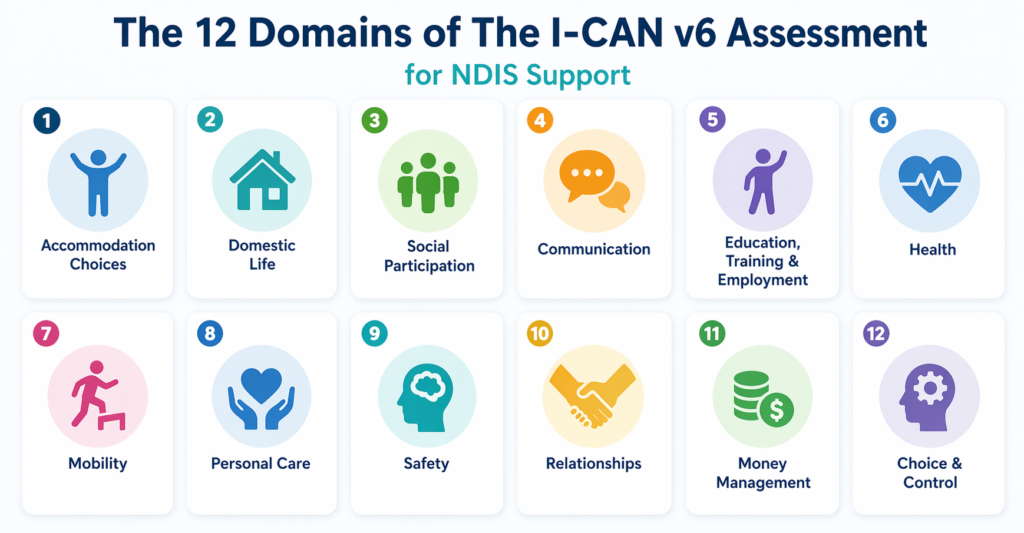
How the I-CAN v6 Process Works
It normally starts by collecting background data regarding your health and life. Then the assessor interviews and observes you at work on daily tasks.
Each activity is scored based on the level of assistance you require. The scores are then analysed to form a clear profile of your needs.
Finally, the results are shared with NDIS planners, who use them to build or adjust your NDIS participant plan. This makes sure that your funding is in line with your real level of support.
Why This Assessment Matters for participants
From mid-2026, the NDIS is introducing a New Framework for planning. The I-CAN v6 Assessment will be a primary tool used by the Agency to determine your funding. To NDIS participants seeking providers, this report is the document that will support your support hours.
Key Areas Covered in the Assessment
The tool looks at domains of your life. It does not ask whether you can walk or talk, but asks about:
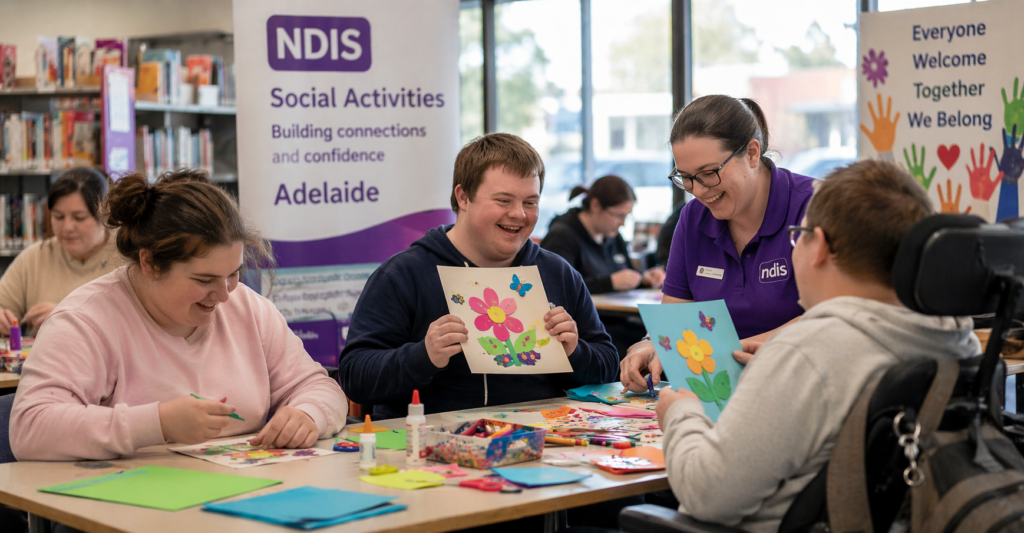
- Social and Civic Life: Do you need help joining NDIS social activities?
- Self-Care: What support do you need to get ready in the morning?
- Health: How do your physical or mental health needs impact your day?
| Domain Area | What it Looks At |
| Communication | How you express yourself and understand others. |
| Domestic Life | Cooking, cleaning, and home tasks require support. |
| Interpersonal | How do you build and keep relationships with others? |
| Community | Accessing ndis funded social activities and transport. |
How to Prepare for Your Assessment in Adelaide
If you are a participant whom residents often rely on, you know that preparation is everything. When an assessor visits you, whether at home or outside. You should have your NDIS participant stories ready.
Think about your worst days, as well as your best. The version 6 assessment relies on I-CAN statements. E.g., rather than saying “I can not cook”, you can say, “I can make a meal. If someone could help me cut the vegetables and watch me to ensure that the stove is turned off. ” This level of detail helps the computer-generated budget accurately reflect your life.
Still, if you feel confused, it is a good thing to contact a local expert who knows the Adelaide landscape. Having a trusted advocate can make the 1-to-3-hour meeting much less stressful.
Finding Support and Providers in Adelaide
Identifying the right team is crucial. Also, local knowledge is important to many participants in residential aged care or private homes. If you are trying to find NDIS participants or groups for social connection, Adelaide has a vibrant community.
Using this v6 Assessment correctly ensures you have enough funding for quality care services. Remember, you don’t have to do this alone. You can always bring a family member, a friend, or a professional from Carers for Care to your meeting to ensure your voice is heard.
Common Challenges and How to Handle Them
Participants can easily experience nervousness or uncertainty in the assessment. Because of the chances, some participants can underestimate their needs or omit pointing out significant challenges.
It may result in support that is not entirely suited to their situation. To prevent this, use your time in the session and talk freely about your daily challenges.
If you do not understand something, you can ask questions and seek clarification. You can also ask to have your plan reviewed in case your needs change in the future.
FAQs
What is the Australian disability assessment tool?
The primary tool being adopted for the NDIS “New Framework” is the I-CAN v6. It is a measure of the support that an individual needs in their day-to-day living.
What are the 6 areas of NDIS?
The NDIS focuses on six main domains: self-care, self-management, social interaction, learning, capacity for self-management, and communication. Those domains determine participants’ functional capacity and support needs.
What are the 4 assessment tools?
While many exist, common NDIS-related tools include the PEDI-CAT, VINELAND-3, and LSP-16. Now the I-CAN v6 is becoming the standard for determining overall support need budgets.
What are 20 points required for a disability pension?
To qualify for the Disability Support Pension (DSP), an individual must score at least 20 points on the Great Australian Impairment Tables. It shows how their condition affects their ability to work.
Final Verdict: Why the I-CAN v6 is Good News
While any change can be scary, the I-CAN v6 Assessment offers a more human way to look at disability. By focusing on what you can achieve with the right NDIS-funded activities. It leaves behind the old medical model and is headed to a place where you are in the driver’s seat. For NDIS participants, this is a chance to clearly define what a good life looks like and get the backing to make it happen.