


Did you know that your NDIS funds are running low, but you only get a new plan every 4 months? It can be really stressful to run out of NDIS funding early. But you’re not the only one, and you have several options. It’s a common scenario for Australians if their residence changes or prices increase. You must take the right step to avoid losing your essential services.
This guide takes you through what happens if your NDIS funding stops before your plan ends. Also, lead on how you can take immediate action and how to keep yourself safe and independent?
Why NDIS Funding Runs Out Before the Plan Ends
It’s not typically an issue of spending too quickly. NDIS Plans are complicated and the world doesn’t always fit in a spreadsheet. Understanding why your NDIS plan budget ran dry helps you explain the situation to the National Disability Insurance Agency (NDIA) when asking for a fix.
Incorrect Support Hour Estimation
When you first set up your plan, you or your planner might have guessed how many hours of help you needed each week. You will find your funding periods not to be long enough. If you compute with a perfect scenario, without considering real-life needs.
Condition or Behaviour Changes
Disabilities are not permanent. Moreover, any sudden changes to your body or your behavior may require additional support. Families who are dealing with ndis funding for autism or ndis autism funding complications. They can find themselves in a situation where they need a week of support workers rather than a day. At this point, they may notice that their NDIS core support budget is being used up quickly.
Hospital Discharge or Sudden Care Increase
In your medical emergency or a hospital stay, getting home safely will likely require a lot of short-term hard work. This rapid growth in NDIS core supports usage can consume months of funding within weeks.
Using the Wrong Funding Category
The NDIS divides up your money into buckets. You may overpay for a service with the wrong category or not be aware that some types of funds are not interchangeable. That can lead to a shortage of funds in one category and a surplus in another.
Provider Under-Utilisation Earlier in Plan
Sometimes, participants don’t use much funding at the start of a plan due to long waitlists for therapists. Once those spots open up. They try to catch up by booking multiple sessions at once and burn the remaining NDIS budget too quickly.
What To Do Immediately When Funding Is Nearly Finished
If you log in to your portal and find that your balance is critically low, don’t worry. Now, implement these four practical steps to manage your plan managed ndis and self-managed NDIS.
Step 1: Do Not Cancel Supports Yet
Your knee-jerk reaction might be to call all workers and cancel your sessions. Don’t do this yet, especially for health and safety services. Canceling abruptly can put you at risk and make it harder to prove to the NDIA that you actually need these ndis funded activities.
Step 2: Speak to Your Provider
Get on the phone with your ndis provider. Be transparent. Let them know your NDIS funding is running low. Many providers can help you consider alternative options or schedule adjustments safely, and are very experienced with this. In need of immediate physical aid around the home, you can explore structured Domestic assistance to re-prioritize immediate surroundings.
Step 3: Check Remaining Categories
Even if your Core ndis funding is empty, you might have money left in Capacity Building or Capital Supports. These main pillars give you a clear picture of your total financial landscape.
Step 4: Identify Critical Supports
Prioritize what is a must-have and what is nice-to-have. Personal care, meal preparation and emergency medical treatments should be prioritized over social outings or less urgent NDIS supports.
Can You Continue Receiving Support Without Funding?
The answer is no, providers cannot provide services for free forever. However, if you are experiencing a crisis, the NDIA has mechanisms to step in.
Recent changes outlined in the debates and the implementation of the Securing the NDIS for Future Generations Bill mean that the NDIA keeps a much tighter leash on overspending. They want to ensure choice and control ndis funding is used sustainably.
While your funds reach zero, you’ll need to apply for an urgent plan variation or unscheduled review. Then you need to prove that stopping your support puts you or the community at immediate risk.
How providers can assist in funding gaps
A good service provider will not leave you hanging when an item goes to zero. They can review the structure of your plan to see if there are flexible funds available
For example, your Core ndis funding is typically flexible. If you’ve been saving money for Transport ndis funding, you can use some of your flexible core funding to help pay for a short period of personal care. If you need specialized transport options during a funding squeeze. Then you need to explore dedicated NDIS funding for transport options. Providers can also help you get therapy reports, the incident log, etc.
How to Avoid Running Out of Funds in Your NDIS Plan
Avoiding budget crises is always easier than solving them! Use these strategies to make sure your cash lasts the full distance of your funding periods.
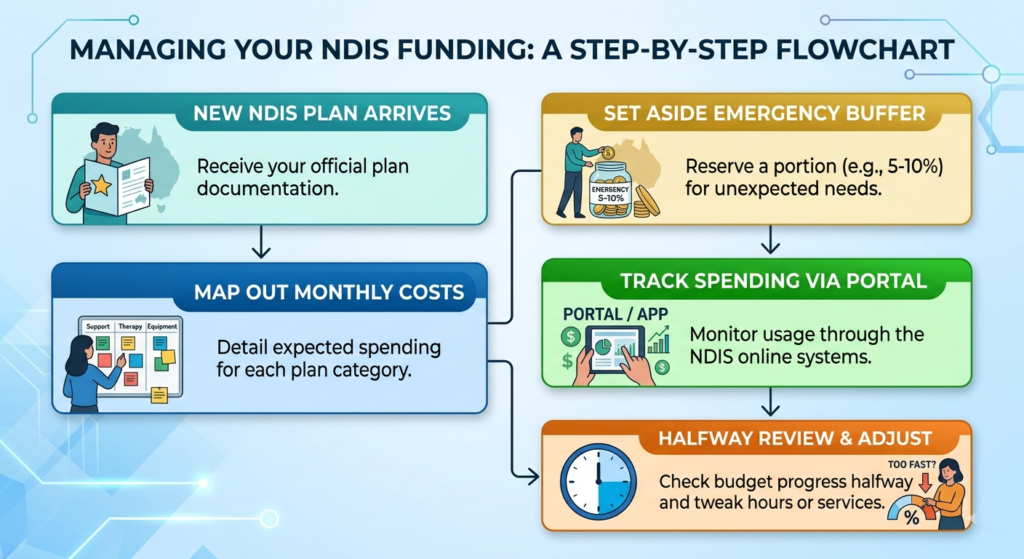
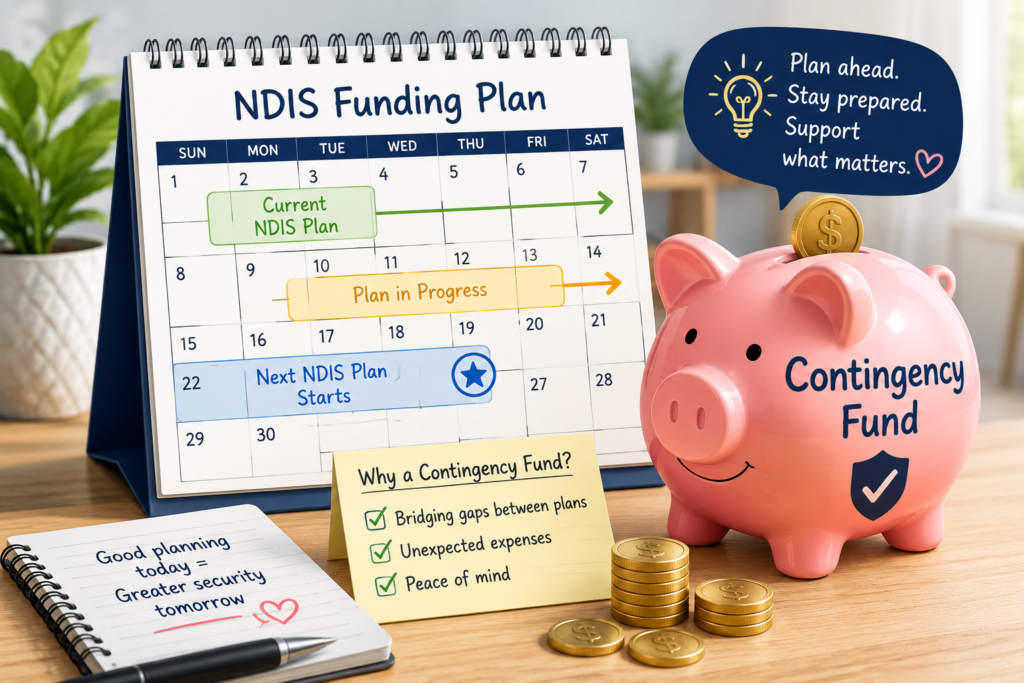
- Set aside a 5-10% contingency amount: Treat this as your emergency emergency fund. Keep out of reach unless a sudden emergency.
- Understand boundaries for categories: Be clear about what’s flexible and what’s locked. For example, Mid-Term Accommodation (MTA funding NDIS) is locked for specific housing transitions and cannot be spent on everyday therapies.
- Plan and prioritize early: As soon as you receive a new plan, draw a line between your fixed costs and the total cost of your plan each week. The official NDIS budget calculator can help you work out your annual funding into smaller monthly limits.
- Play by the month: If you are using an ndis managed plan, log into the myplace portal on a regular basis. Use plan management, then keep a close eye on your monthly statements to avoid going over the limit.
- Check at the halfway point: At the midpoint of your plan period, review how much you have left. If you’ve used over half, then it’s time to cut back on non-essential activities or ask for a proactive plan review.
Looking at Other Possible Funding Options
At the end of all options, you can consider mainstream community services. They are worth considering if the NDIA has declined to approve an urgent top-up. Besides, State health systems, non-profit charities, and local community health centers may offer temporary respite or personal care in emergencies at times.
Tying Up Your Budget Plan
When the NDIS funding runs out before you expect it to, it can feel like a big deal. However, there is a way to deal with the situation immediately and in a structured manner. Ensure you communicate with your providers, regularly monitor your monthly bills, and don’t be afraid to speak with the NDIA. The way to manage a disability plan is a learning process. The planning, in a way, will help you stay in control of your lifestyle and your long-term care goals.
Frequently Asked Questions
How does ndis funding work?
The NDIA packages are based on your functional goals. Funds remain in categories such as Core or Capacity Building to be allocated to providers of approved services.
What can ndis funds be used for?
Funds are for reasonable and necessary support that is directly related to your disability, such as access in the community, equipment, therapies, and personal care.
What does ndis stand for?
NDIS is the National Disability Insurance Scheme. It’s a program run by the Australian Federal Government to help eligible people across Australia.
What happens if I don’t use all my NDIS funding?
Unspent funds are not carried over to the next cycle. The scheme pool is where it goes back. So it is important for the NDIS budget management of the scheme.
Who is eligible for ndis?
You need to be aged from 7 to 65 and be an Australian citizen or permanent resident with a permanent disability. That has a significant effect on your everyday life to be eligible.